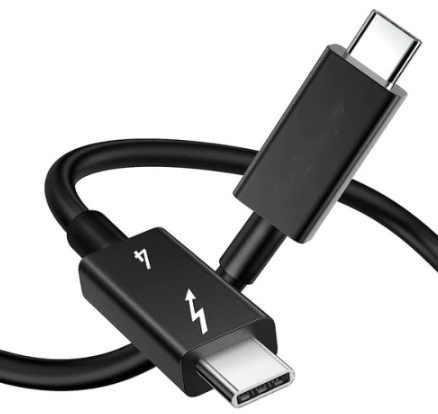
Are you cluttering up your desktop because your USB C hub cables are too short? While extension cables may seem like a straightforward solution to the problem, overly long cables can cause signal loss and affect the normal operation of USB devices. This article will explore the length limitations of USB cables and provide several effective extension solutions.
USB Cable Length Limitations
USB connections do have length limitations. To achieve full Gen 3 40Gbps performance, USB4 cables must be shorter than 0.8 meters. Gen 2 or 20Gbps cables can be up to 2 meters long. Beyond these lengths, while the cable may still work, performance may be affected.
USB Standards, Bandwidth and Recommended Cable Lengths:
|
USB Version
|
Bandwidth
|
Nominal Cable Length
|
|
USB 1.0 (Full Speed)
|
12Mbps
|
≤ 3m (9.8ft)
|
|
USB 2.0 (High Speed)
|
480Mbps
|
≤ 5m (16.4ft)
|
|
USB 3.2 Gen 1
|
5Gbps
|
≤ 3m (9.8ft)
|
|
USB 3.2 Gen 2
|
10Gbps
|
≤ 3m (9.8ft)
|
|
USB 3.2 Gen 2x2 (USB C only)
|
20Gbps
|
≤ 3m (9.8ft)
|
|
USB4 (USB C only)
|
40Gbps
|
≤ 0.8m (2.6ft)
|
For Thunderbolt 3, active Thunderbolt 3 cables support 40Gbps data transfer speeds within a 2-meter length. Passive, low-cost cables can only achieve 20Gbps speeds at 1 or 2 meter lengths, but can reach full 40Gbps speeds at shorter cable lengths of 0.5 meters. Fiber optic cables offer longer length options, up to 60 meters.
Ways to extend the length of a USB cable
Despite the length limit, there are several ways to extend the length of a USB cable:
1. USB extension cable (active or passive):
Purchasing a passive or active USB extension cable is the simplest solution. However, if the total connection length exceeds the effective limit of the cable, it may result in weak signals and packet loss. The problem may be more serious when using a passive extension cable. To ensure the best results, it is recommended to use an active extension cable (also known as a USB repeater) when the nominal limit is exceeded.
2. USB hub:
USB hubs not only provide additional ports, some are also equipped with a fairly long main cable that can extend the length of the USB cable in an emergency. But please note that the extended length should not exceed the recommended connection length to avoid communication delays.
3. USB Ethernet extender:
The USB over Cat5e/Cat6/Cat7 Ethernet extension adapter is a hub that converts USB signals to be transmitted over an Ethernet cable. This extender can transmit data up to 50 meters without signal loss and at speeds of up to 1000Mbps. But please note to distinguish it from a USB network adapter.
4. USB over Fiber Extender:
The USB over Fiber extension adapter transmits USB signals over a fiber optic cable and is the best choice for achieving maximum distance. Speeds of 5 to 10Gbps can be achieved when using USB 3.0+ devices and cables and fiber optic cables. This extender is ideal for devices such as printers and scanners that need to be at a long distance from a laptop or PC.
When trying these extension solutions, it is important to note that the speed of the slowest part of the entire connection will become the bottleneck of the entire connection. Therefore, weigh performance against length needs when choosing an extension method.