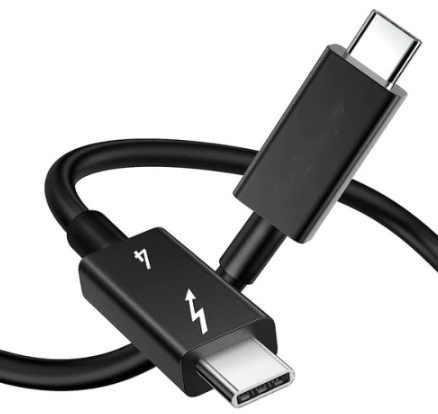
Now, let’s delve into the latest USB-C connector type standard: USB4, and explain how it helps IT professionals enhance the productivity of business users.
USB4 represents a significant upgrade compared to earlier USB 3.0 standards. It uses the USB-C connector like Thunderbolt 4, supports video passthrough, and can provide power delivery of up to 100W, along with audio and video signals. However, Thunderbolt 4 has stricter mini-mum requirements than USB4; for example, TB4 must support at least dual 4K displays, whereas this is optional in USB4. In the table below, you can see some other major differences in mandatory/optional support between them.
Next, let’s identify the functions of USB-C ports:
If you are unsure whether the host devices in your organization with USB-C (such as laptops) are compatible with USB4 or Thunderbolt 4, you can confirm this through the following four methods:
1. Processor:
If the device is equipped with an Intel® Evo™ or Intel® Core™ vPro® processor, it should have at least one Thunderbolt 4 port (this also applies to USB4 devices).
2. Logo:
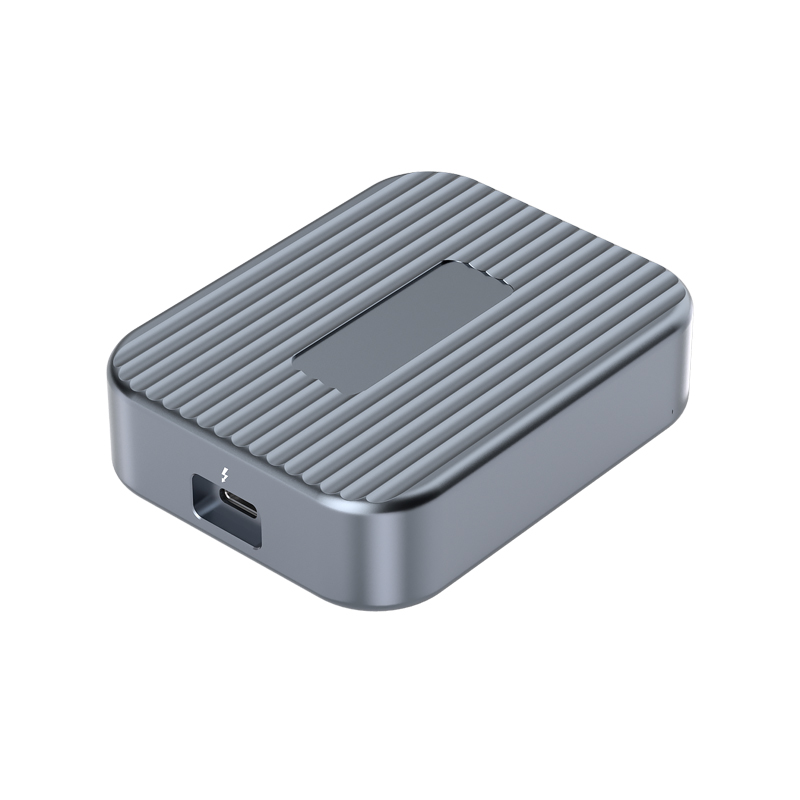
On other systems, if the USB-C port has Thunderbolt 3 or Thunderbolt 4 capabilities, it will typically feature a distinctive Thunderbolt logo. While some manufacturers may use different icons to indicate USB4 capabilities, this is not standardized.
3. Device Manager:
If the above two checks do not clarify the situation, the system may have USB4 instead of TB4. In this case, you can check the capabilities of the USB-C port under “System Devices” in the “Device Manager.” The presence of USB4 or Thunderbolt controllers can indicate whether one or more USB-C ports on the device support USB4 or Thunderbolt.
4. Host System Documentation:
For some systems, the simplest method is to consult the documentation. For Apple products, you can refer to the “Identify ports on your Mac - Apple Support” page. For other products, you can search online using keywords like “[system brand/model] USB-C port” and look for the manufacturer's product specifications page. In the “Ports” section, look for keywords like “Thunderbolt 3,” “USB 3.2 Gen 2 Type-C power delivery support,” or “Thunderbolt 4 USB-C.” Note that formats and terminology may vary, and further clarification may be needed.
Additionally, we need to clarify the limitations of USB-C:
Just because a host device (like a laptop) or peripheral device (such as a laptop dock) is equipped with a USB-C port does not guarantee its actual capabilities. In fact, a USB-C port may only support USB 2.0 data transfer (circa 2000 standard) and not support any other advanced features. To understand the capabilities and advantages of a specific device or USB-C device combination, you need to know the specific protocols supported by each component (including cables). In this regard, USB4 or Thunderbolt 4 can provide some clear guidance.
USB4 Advantages for IT Pros
The first consumer devices with USB4 were introduced by Apple in November 2020, and since then the number of devices with support for USB4 has grown substantially to include motherboards, laptops, docking stations, drive enclosures and more. While the specification continues to evolve, USB4 can make life easier for IT Professionals and improve productivity for business users in a variety of ways already:
。Faster transfer rates up to 40 Gbps: transfer large files such as videos quickly and efficiently.
。Improved video bandwidth: optionally connect multiple monitors to a single USB4 port.
。Optional compatibility with Thunderbolt 3: use Thunderbolt 3 devices with USB4 ports.
。Backward compatibility with USB 2.0 and up: continue to use old devices with new USB4 ports.
。Power Delivery (PD) of up to 240 watts: charge laptops and other devices quickly and efficiently.