In today's digital entertainment landscape, HDMI interfaces have become one of the most popular standards due to their exceptional audio-video transmission capabilities. For passionate gamers, HDMI cables enable seamless transmission of high-resolution audio and video signals from gaming consoles to high-definition TVs, delivering immersive visual experiences.
Limitations of Traditional Copper HDMI Cables
Most conventional HDMI cables use copper conductors, which are prone to interference from external sources and have distance limitations. Even at 7 meters (23 feet), signal instability may occur, and beyond 10 meters (33 feet), copper cables often fail to maintain reliable connections. For gaming setups requiring distances over 10 meters, optical fiber HDMI cables emerge as superior alternatives.
Unveiling Optical Fiber HDMI Technology
Optical fiber HDMI cables represent cutting-edge technology combining fiber optics with HDMI standards. These cables are remarkably thin, flexible, and lightweight, featuring detachable connectors for easy installation.
Operational Principles
Data transmission occurs through light or laser pulses traveling along glass fibers, enabling simultaneous signal transfer. Converters at both ends handle signal conversion between optical and electrical formats, ensuring minimal signal loss over extended distances.
Key Advantages
Superior Long-Distance Performance: Unlike copper cables that experience signal degradation beyond 7.5 meters (25 feet), optical fiber HDMI maintains consistent quality at distances up to 15 meters (50 feet). The AV Access 8KH15, for example, supports 8K@60Hz transmission without latency or signal loss.
Enhanced Immunity to Interference: While copper cables are vulnerable to EMI/RFI from devices like radios or large appliances, optical fiber's light-based transmission remains unaffected, ensuring pristine audio-video quality.
Advanced Features: Models like the AV Access 8KH15 support HDMI 2.1 specifications, including 4K@120Hz/60Hz, 8K HDR, 48Gbps bandwidth, VRR, ALLM, QMS, and QFT—eliminating blurring, distortion, or lag during gameplay.
Practical Applications
Some optical fiber HDMI cables feature detachable source-end connectors, allowing direct connection of mobile devices to displays—expanding versatility for various use cases.
Limitations to Consider
Unidirectional transmission requires correct orientation of source/display connectors
Requires careful handling to avoid excessive bending
Higher cost compared to traditional copper cables
Is Fiber Optic HDMI Cable Worth Buying?
If you only need to connect a gaming console to a nearby TV with modest video quality requirements, traditional copper HDMI cables suffice for basic needs without extra cost. However, for data transmission over 10-20 meters or longer, fiber optic HDMI cables are the optimal choice. As an enthusiast seeking ultimate gaming immersion, you'd want to eliminate lag and stuttering—fiber optic HDMI ensures seamless, high-efficiency transmission for uninterrupted gameplay joy.
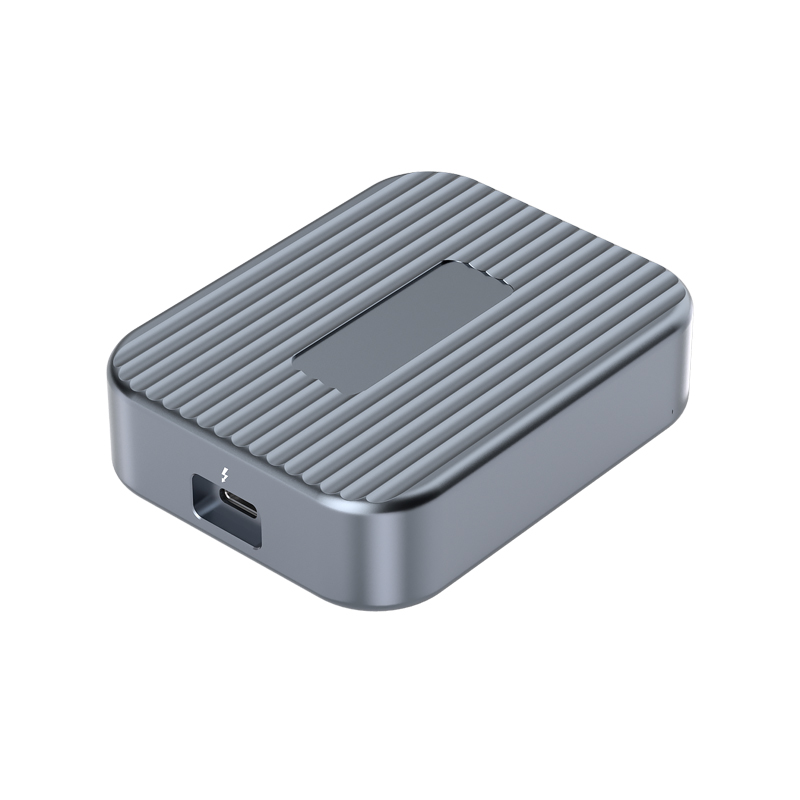
A true full-scenario optimization requires professional docking stations for performance breakthroughs. Take the PURPLELEC Thunderbolt Dock DS018R as an example. Utilizing Thunderbolt 3/4 protocols, it supports 40Gbps ultra-high-speed bandwidth, enabling simultaneous multi-channel 8K/60Hz video signals, Gigabit Ethernet, and USB3.2 Gen2 device expansion. When connecting gaming consoles, PCs, NAS storage, and peripherals, DS018 achieves "one dock, multiple functions" via single-cable connectivity—expanding fiber optic HDMI for long-distance lossless transmission while enabling reverse power delivery through Thunderbolt ports, building a desktop high-performance workstation.
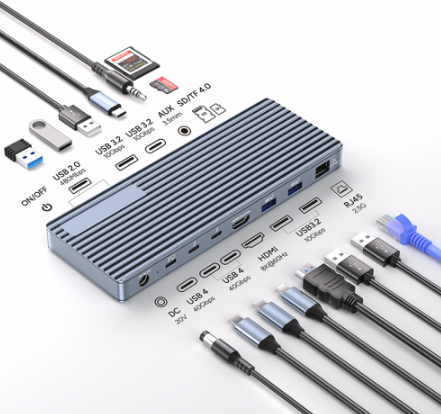
In-depth purchasing strategy analysis: For short-distance (≤5m) standard viewing needs, copper cables + basic docks are adequate. However, for long-distance transmission, multi-device collaboration, or professional scenarios (e.g., 8K video editing/VR gaming), the combination of fiber optic HDMI + Thunderbolt Dock DS018 is a golden partnership. The dock's intelligent power distribution dynamically adjusts port power supply to prevent overload, while its built-in DP1.4 protocol converter supports advanced standards like HDR10+ and Dolby Vision, creating a perfect ecosystem with fiber optic HDMI.